
After much delay I am finally ready to start this post.
First I would like to thank David Hoskyn from Monarch Music for arranging for the drum Mics I used for the samples.
Also thank you to my friend, Merv Larken for playing the drums for the samples.
In the clips I used the following Mics:
- Shure SM57
- Shure PG56
- Shure PG 52
- Behringer C2
Cajon
For the first set of comparisons I am looking at the Cajon. A discussion with some friends about this exact topic contributed to the idea on starting this blog.
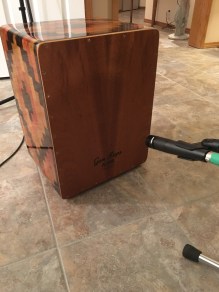
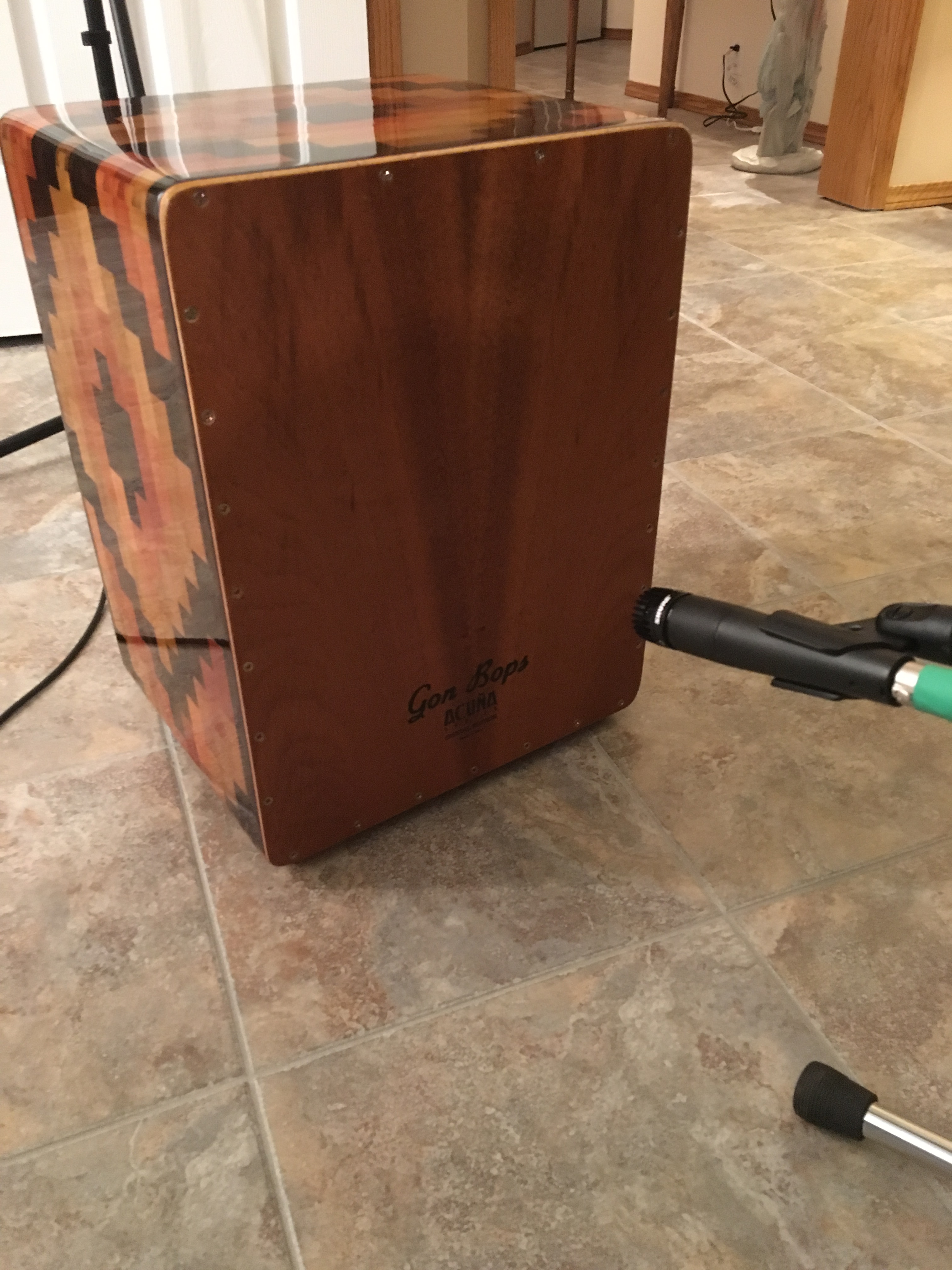
This pics shows front mic placement for a Cajon.
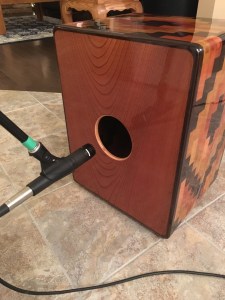
This pic is how I have placed a mic for a Cajon, from the back.
Which is correct? Well as you will see and hear, I guess it depends on the sound you are after.
-On a side note let me talk about the placement of a mic in relationship to a port on an instrument. I have found for best results: imagine the port has a ball in it the same diameter as size of the port. The mic should be placed outside the surface of the ball to prevent unwanted wind noise on a mic. For example, if the port is 4″ across place the mic at least 2″ from the port.
Back to the comparisons.

In the above screen shot, the top channel was produced using front mic placement and the bottom channel is rear or back placement by the port.
Front placement clip
As you can hear there are more mids and highs allowing you to hear the sound of the surface and the snares vibrating. (Provided that the Cajon you are micing has snares in it.)
Back placement clip
With this placement you also get to hear the body sounds of the Cajon, including more lows. You can still hear some of the mids and highs.
This next clip is combining both front and back with the back mic in reverse phase. Look for a button with this symbol on it “ø” for phase reversal on your mixer.
I find this option is best but you may not have enough extra channels or mics to do this.
Why phase reverse the back mic? Phase reversing will be a topic I will cover in more detail in a future post. For this post: when you place two mics facing each other, they are also out of phase with each other, so by reversing the phase on one mic you eliminate cancelation of the two mics.
For myself: if I only had room for one mic I would chose the back placement to get more of the body sounds.
Dumbec Click here to find out what a Dumbec is.
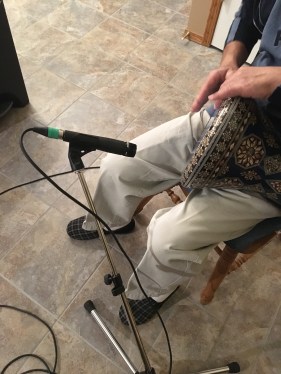
Micing a Dumbec or similar drum. Above is the front mic placement
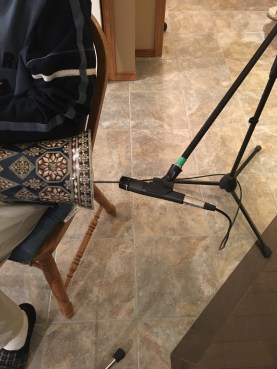
This is the rear mic placement
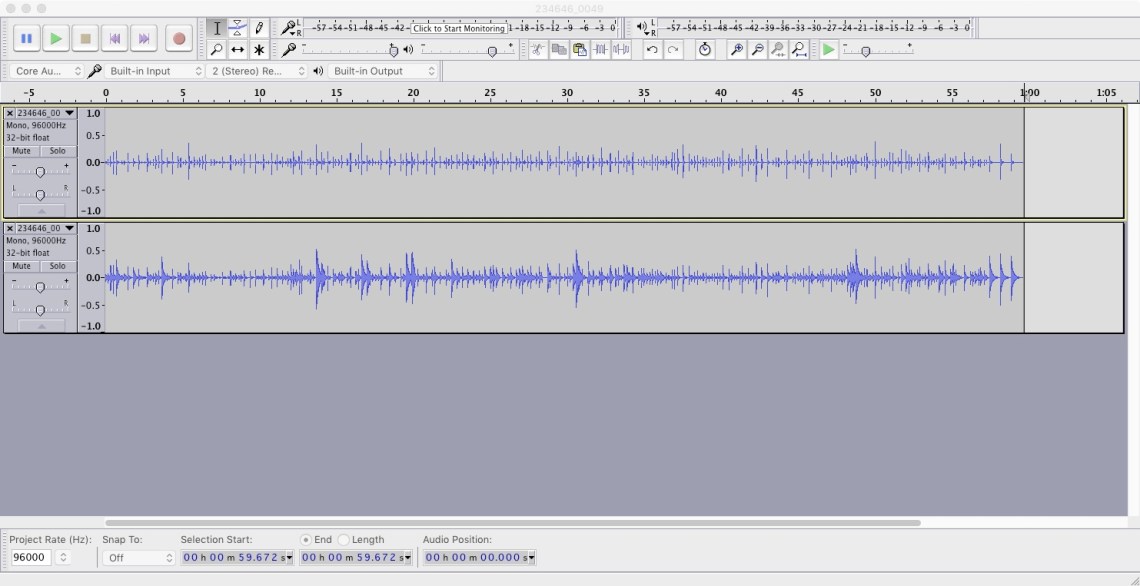
The top waveform is the front mic and the bottom is the back or rear mic.
The first clip is the front mic.
Again you get more mid and highs and less body or lows with the mic in this placement.
Here it is with the back.
More body sound or lows are present.
Here is front and back combined with the back mic phase reversed.
This, in my opinion, gives a much fuller sound. If I had only one mic available I would place the mic in the back for the same reason I would on the Cajon.
Stay tuned for part two
As before please feel free to comment or contact me with your questions or anything else you would like to see covered.

 Wide Q